Random Name Selector App

Random Name Selector icon

Random Name Selector app for iPhone/iPad (free and Pro 1.99) is by the developers at Walsall Academy (developer of Too Noisy and more). They seem to know the needs of the classroom providing some great classroom management tools!

Random Name Selector app provides a method of randomly drawing student names when engaging in group activities. Here is an image of the app:

Random Name Selector pic1

The Random Name Selector app is a useful tool for anyone working with large or small groups of students or adults for that matter! I would also guess that by creating a group with activities or tasks could generate another fair method of choosing tasks. Those weekly classroom chores can be generated using the app just to change thing up a bit! What you can’t do with an app!

Thank you to Mrs. Koene for cluing me in on this great classroom mTool! Check out Walsall Academy website for more of their classroom management apps!

Carol

Posted in App Reviews, Apps for OT's, Free apps, Game, iPhone, iPod, Occupational Therapy, School Based Interventions | 3 Comments

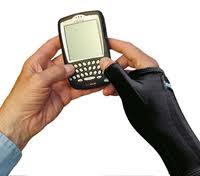
Ergonomics and “Texting Thumbs”

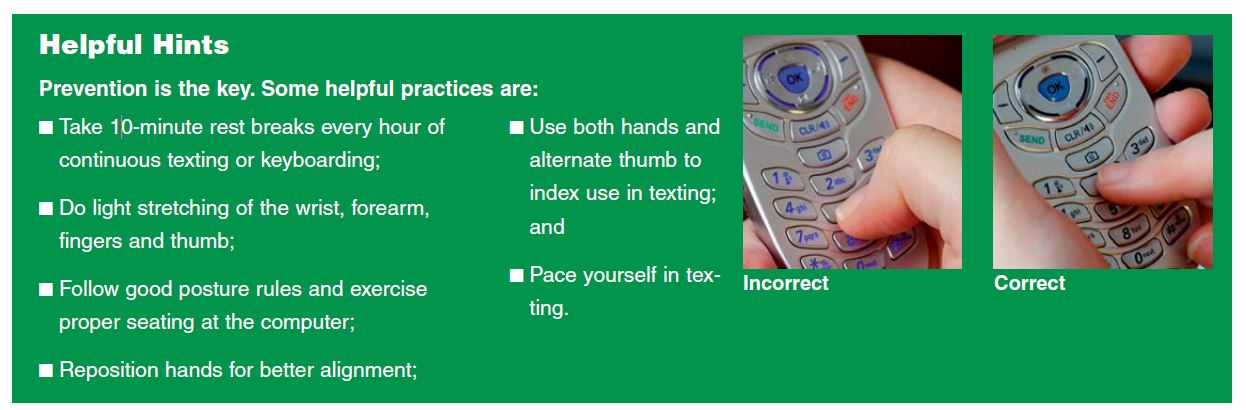
texting thumb

Virginia Hixson’s article on Ergonomics for Text Messaging  previously posted provides information on research and ergonomic solutions for discomfort associated with Repetitive Strain Injury (RSI) and one specific RSI injury called De Quervain’s Tenosynovitis  . RSI and De Quervain’s has been increasingly identified with discomfort associated with excessive text messaging on handheld devices  in adults, teens and children (Partin, C, ND; Ashurst, Turco, Lieb, 2010; Narain, 2006). I found it described in numerous ways including Blackberry Thumb, Nintendo Thumb/Nintendonitis, Teenage Texting Tendonitis (Sadler, 2012) or Texting Thumb (Amadio. n.d.; ).

So what exactly are the symptoms and causes RSI or De Quervain’s Tenosynovitis related to use of mobile devices? Here is some basic information I found on Mayo Clinic website:

Symptoms of De Quervain’s tenosynovitis according to Mayo Clinic include:

  • Pain near the base of your thumb
  • Swelling near the base of your thumb
  • Difficulty moving your thumb and wrist when you’re doing activities that involve grasping or pinching
  • A “sticking” or “stop-and-go” sensation in your thumb when trying to move it

If the condition goes too long without treatment, the pain may spread farther into your thumb, back into your forearm or both. Pinching, grasping and other movements of your thumb and wrist aggravate the pain.

Other symptoms identified with RSI with texting can include (Partin, C., n.d.):

  • Stiffness
  • Cramping
  • Numbness
  • Fatigue
  • Swelling
  • Symptoms can start intermittantly and worsen with activity

Causes:

Chronic overuse of your wrist is commonly associated with de Quervain’s tenosynovitis.

When you grip, grasp, clench, pinch or wring anything in your hand, you use two major tendons in your wrist and lower thumb. These tendons normally glide unhampered through the small tunnel that connects them to the base of the thumb. If you repeat a particular motion day after day, it may irritate the sheath around the two tendons, causing thickening that restricts the movement of the tendons. Other causes of de Quervain’s tenosynovitis include:

  • Direct injury to your wrist or tendon; scar tissue can restrict movement of the tendons
  • Inflammatory arthritis, such as rheumatoid arthritis

Habitual texting certainly can contribute to the condition and also has been found in texting teens (Sadler, 2012)

Interventions

Virginia Hixson’s article has a number of ergonomic suggestions in her article Ergonomics for Text Messaging.  Massachusetts Institute of Technology also provides four keys to RSI intervention  listed below with additional online interventions included for “text thumb” or Blackberry Thumb” including Mayo Clinic’s Life Style and Home Remedies. Suggestions of handheld apps are included in Techniques for possible hands free or key input reduction.

  1. Position – Watch your hand position when you text
  • Keep your wrists in neutral when texting
  • Rest your arms on a table or surface whenever possible to reduce the need to bend your neck for long periods of time
  • Don’t hunch over when texting as it also has been shown to contribute to neck, shoulder and back problems (University of Gothenburg, 2009)
  • Wear a brace or splint if suggested by your doctor.

2. Pacing  – Limit the amount and length of time you text

  • Reduce the time you spend texting
  • Take a break if you are texting for a long time
  • If you are doing a lot of texting use a keyboard you can attach to your handheld device

3. Technique – Being mindful of how you are texting can be helpful

  • Position your hands for better alignment with wrists held at neutral position.
  • Avoid moving your hands and wrists the same way repeatedly, vary your activity
  • Use of a stylus might also offer a different position and movement when texting
  • Take special note of any activity that causes pain, swelling or numbness in your thumb and wrist, try to avoid it, and share that information with your doctor.
  • Utilize apps available for voice recognition, abbreviation expansion or word completion to reduce key input associated with texting:

4. Exercise – There are recommended gentle stretching exercises to help relieve the symptoms of text thumb. Consult a physician if the symptoms increase.

Summary

There is a lot of information on the web on the subject. Here is one additional article from Advance for PT: “Texting and Hand Health” : http://physical-therapy.advanceweb.com/Features/Articles/Texting-and-Hand-Health.aspx

An increase in RSI has been found in children, teens and adults due to texting. Be mindful of ergonomics when using handheld devices no matter what the age to reduce long term effects of overuse and poor positioning!

Note: The above information is not a substitute for evaluation or treatment from a physician. Consult your physician for prolonged pain or discomfort .

Resources:

Ashurst, Turco, Lieb, 2010., “Tenosynovitis Caused by Texting: An Emerging Disease”. J Am Osteopath Assoc May 1, 2010 vol. 110 no. 5 294-296

Relief-for-texting-thumb. Jefferson Hospital, Aug. 2012. Web. 23 Feb. 2013. <http://www.jeffersonhospital.org/keep-in-touch/august-2012-issue/relief-for-texting-thumb&gt;.

Mayo Clinic. Mayo Clinic, n.d. Web. 23 Feb. 2013. http://www.mayoclinic.com/health/de-quervains-tenosynovitis/DS00692.

Muse, Trish.  How to Relieve Blackberry Thumb. N.p., n.d. Web. 23 Feb. 2013. http://www.monkeysee.com/play/7441-how-to-relieve-blackberry-thumb.

McEvoy, Cheryl. “Texting and Hand Health.” Advance for Physical Therapists. Advance, 10 July 2010. Web. 23 Feb. 2013. <http://physical-therapy.advanceweb.com/Features/Articles/Texting-and-Hand-Health.aspx&gt;.

Narain, Jaya. “Eight-year-old Text Queen Has Repetitive Strain Injury.” Daily Mail.com. Daily Mail, 8 June 2006. Web. 23 Feb. 2013. <http://www.dailymail.co.uk/news/article-389800/Eight-year-old-text-queen-repetitive-strain-injury.html&gt;.

Partin, Christine. (n.d.): n. pag. “Thumb Hurt? Wrist Sore? Hands Tired? Text Messaging May Be to Blame”,. Miami Valley Hospital. Web. 23 Feb. 2013. http://www.miamivalleyhospital.org/uploadedFiles/mvh/Health_Information/v26i1_text.pdf.

“Potential Risks of Computer Games and Text Messaging.” RSI.org. N.p., n.d. Web. 23 Feb. 2013. http://www.rsi.org.uk/pdf/games_and_texting.pdf.

“RSI: What You Absolutely Need to Know.” MIT, n.d. Web. 23 Feb. 2013. http://web.mit.edu/atic/www/rsi/needtoknow.html.

Sadler, Jane. “Teenage Texting Tendonitis.” Health Blog. Dallas News, 12 June 2012. Web. 23 Feb. 2013. <http://healthblog.dallasnews.com/2012/08/win-50000-dollars-and-you-may-get-teenage-texting-tendonitis-as-a-bonus.html/&gt;.

“Virgin Mobile SafeText.” Textercises.” Virgin Mobile, n.d. Web. 23 Feb. 2013. <http://www.practisesafetext.com/&gt;.

University of Gothenburg (2009, June 24). How To Text Message And Avoid Sore Thumbs, Neck And Hands. ScienceDaily. Retrieved February 23, 2013, from http://www.sciencedaily.com­ /releases/2009/06/090623150131.htm

Carol

Posted in Activities of Daily Living, Android, Apps for OT's, Ergonomics, Finger Isolation, iPhone, iPod, Mobile Device Use, Occupational Therapy, Rehabilitation, Voice Recorder | Tagged , , , , , | 2 Comments

More Noise Regulation Apps

Review of the TooNoisey app generated a few comments about possible use in classrooms along with additional apps that may help with noise regulation issues. Kim Wiggins shared a few more apps she has used for noise regulation issues:

Quiet Please iconQuiet, Please! for iPhone and iPad (.99) and Android (free) is an interactive adventure game that requires interactive problem solving to manage annoying situations (… After an annoying day at school, you just want some peace and quiet. But everything at home is so noisy! – Sound familiar with your SPD kids?).  Sounds like a fun app to explore!

The Quiet Game iconThe Quiet Game for iPhone and iPad (free) and Android (free) features a game to stay quiet at home, in the car or at school.  Here is a video of the Android app:

Thank you to Kim Wiggins for sharing these apps which are appropriate for many environments : home, auto and classroom!

More for your school, home or OT mTool Kit!
Carol

Posted in Android, App Reviews, Apps for OT's, Apps for Special Needs, Autism, Emotions, Free apps, Game Apps for Special Needs, iPad, iPhone, iPod, Occupational Therapy, Self-regulation, Special Needs | Tagged , , , , , , , | Leave a comment

Medicare Approved iDevice for Communication

FRS solutions aac

Here is a tip offered by Assistive Technology Daily in a recent post that caught my attention due to the difficulty with getting funding for Apple based products for communication devices.

FRS Custom Solutions  (Forbes Rehab Services), a Ohio based business offers devices for individuals with communication disorders that are Apple based with a choice of adding your own communication app that is Medicare approved. 

The Com Link ProSlate 10, is an AAC device advertised by FRS as an Apple based AAC device Medicare approved as a speech generating device.

FRS AAC Device

Here is what they list as included with this AAC device:

ProSlate™ 10D
SoundPOD™ Wearable
Speaker
FlexABLE™ Handle & Stand
Choice of AAC App (Proloquo2go, Gridplayer, Sonoflex, etc.)
ProSlate™ &
SoundPOD™ Charger
Soft Carry Case
Shoulder Carry Strap
Quick Start
Guide
Stylus

An interesting possibility to check into when considering funding of an Apple device for AAC. Has anyone had experience with this service or device?

Carol

Posted in Apps for Special Needs, Augmentative Communication, iPad, iPod/iPad Accessory, Mobility Impairment, Occupational Therapy, Physical Disability Tool | Tagged , , , , , , , | 3 Comments

Texting Ergonomics

Virginia Hixson, OTR, CPE is the Ergonomic Editor for BellaOnline.com. I stumbled upon her article  “Texting Ergonomics” and found it an interesting read with research provided on posture and repetitive stress as a result of using handheld devices. Relevant to the current frequent use of handheld mobile devices by adults as well as students these symptoms may be seen more frequently. Virginia Hixson provides information on the symptoms as well as healthy tips in her article as reposted with her permission from her ergonomic articles from BellaOnline.com:

Texting Ergonomics

Quick, repetitive movements over an extended period of time have been closely linked to tendon and tendon sheath disorders, in particular tendinitis and tenosynovitis. the thumb is not immune to these conditions. In fact, due to its high mobility it may be even more easily compromised than other body parts.

PubMed literature search of scholarly articles resulted in 42 articles. All but eight were discarded as they did not directly relate to texting. Remaining were one from Malaysia, One from South Africa, one from Finland and two from Sweden, one from Pennsylvania, one from Taiwan, one from Poland, and two from Canada.

Posture or Repetition

Several non–juried articles indicated that as much trouble as the repetitive, quick motions were, the general posture people used when texting was even more of a problem. The small size of the devices used for texting makes using both hands very difficult unless a shoulders forward and hunched posture is used. This overall posture affects every down–stream structure.

Berolo, Wells and Amick from Canada found a strong relationship between the amount of time people spent using their mobile device and right shoulder and neck pain (95% confidence level). Interestingly, base of the right thumb pain was just as strongly related to internet browsing. Perhaps the thumb is not where we should be looking for mobile device effects.

Texting ergonomics pic1
On the other hand, Ming, Pietikainen and Hänninen at the University of Kuopio in Finland found texting as the probable cause of subluxation of the right thumb and arthritis in the Carpal–Metacarpal Joint(CMC — Wrist to Thumb joint). But this is a single case.

In Taiwan, 12 college students were studied for muscle response in shoulder and thumb, Blood volume pulse from the middle finger, temperature of the middle finger, respiration while texting, and when not texting. The students were very familiar with texting. The results showed increases in all measures except respiration when the students were texting. They held their breath while texting. Skin response indicated excitement when they received text messages. Eighty-three percent of the students reported hand and neck pain while they were texting.

Now we have two articles supporting the postural set in neck and shoulders potential problems.

Texting ergonomics pic2

Ashurst, Turco and Lied from Pennsylvia looked at De Quervains tenosynovitis and texting. The most common cause of De Quervains is overuse of the thumb. This is a case study bilateral DeQuervains in a rural woman who did lots of texting. Limiting her texting and following normal conservative treatment for De Quervains resulted in a complete recovery.

Gustafsson, Johnson, and Hagberg from the University of Gothenburg in Sweden found that the quicker and more constant the thumb movement, the more likely a person is to experience pain and to develop stressors that may lead to injury.

Professionals across the spectrum of health care generally recognize that texting is probably a significant cause for the recent increase in De Quervains Tenosynovitis. The Canadian Occupational Health and Safety Association, the American Society of Hand Therapists and others all agree that Texting is problematic.
Who am I to argue?

It seems that the ergonomics risks in texting are the same as Ergonomic risks with any keyboard activity. Amount of repetition, Speed, Force and Posture are the main issues.

Here are some tips for good thumb health

  • Try to vary your posture. Sit back, sit forward, even slouch for a few minutes. Variety will assist in your protection.
  • Take frequent breaks
  • Hold the device with your wrists in a neutral posture.
  • Use the chair backrest most of the time.
  • Support the weight of your arms by resting them on a table when possible. This keeps the device fairly close to your eyes and reduces neck flexion.
  • Stretch your arms out and open your chest occasionally.
  • Use both thumbs. This lessens the probability of injury.
  • Stand up and stretch
  • Don’t try to do a long message all at once. Give your thumbs a break.
  • Don’t type too fast. That’s been shown to increase liklihood of injury.
  • Use keyboard shortcuts and abbreviations. Teach them to others so they can understand you.
  • As much as possible, bring the device to your eyes instead of your eyes to the device. This will help in maintaining good posture.
  • Stop frequently to slowly and gently stretch your hands and fingers. NEVER stretch into pain.
  • Be aware of your body. Be on the alert for discomfort, or a feeling of poor circulation in the arms and hands. If this occurs, stop texting and stretch
  • If you begin to feel lasting or recurring pain, see your Doctor.

Thank you to Virginia Hixson, OTR, CPE for permission to repost her article.

Reference: Retrieved on 2/19/2013 from : http://www.bellaonline.com/articles/art31215.asp

Carol

Posted in Android, Ergonomics, iPhone, iPod, Mobile Device Use, Occupational Therapy | Leave a comment

WriteForSchool App – Free

Write for School icon

WriteForSchool App, a handwriting iPad app is currently free (previously 5.99) for an unknown time. Here is some basic information about the WriteForSchool app from iTunes:

WRITE FOR SCHOOL PROVIDES
*A selection of international handwriting styles (fonts) used by your child’s school.
*Professional voiceovers in a variety of accents.
*Correct handwriting tuition to develop fine motor skills.
*Verbal prompts or auditory cues to identify differences in letter blends eg “sh” and “ch”
*Bright stimulating graphics to match sounds and letters.
*A program for parents to introduce lower and upper case letters and sounds to their children.

For a more in-depth review previously posted on OT’s with Apps click on this link: WriteForSchool – Customizable Letter Formation App

For customization of letter formation, give this app a try. Share with others what your experience is with the app !

Happy handwriting apping!

Carol

Posted in App Reviews, Apps for OT's, AT for Handwriting, Handwriting, iPad, Letter Formation, Occupational Therapy, Writing | Tagged , , , , , , | 6 Comments

Geoboard App

20130217-074636.jpg
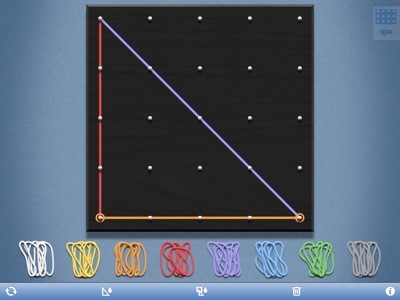
Geoboard app is a free iPad app providing an electronic method of producing geometrical designs on a 25 or 150 peg Geoboard. With 8 different colored bands, a wide variety of geometric models and levels of math instruction can be presented. Developed by Math Learning Center, it is described as ” a tool for exploring a variety of mathematical topics introduced in the elementary and middle grades. Learners stretch bands around the pegs to form line segments and polygons and make discoveries about perimeter, area, angles, congruence, fractions, and more.”

Sound familiar? Yes the same old Geoboard used for years only in an electronic format. Here is what each board looks like:

20130217-074706.jpg

20130217-075131.jpg

As an OT, my preference with Geoboards is the actual pegged board and rubber bands requiring haptic, graded fine motor control and bilateral skills along with visual perceptual abilities provided the possibilities of multiple layers of intervention. Use of an electronic Geoboard, however also has its advantages for learning mathematic principles or when just working on visual perceptual concepts. Presenting the Geoboard as an alternative to the real board certainly can be done easily when physical materials aren’t present or the electronic app is a motivator for engagement.

Try Geoboard app out and share how you might use it with your students.

Carol

Posted in App Reviews, Apps for OT's, Math, Visual Perception | Tagged , , | 3 Comments

RJ Cooper’s LargeKey and Big Blue Keyboards for the iPAD

20130214-081750.jpg

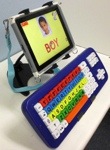
RJ Cooper has been a developer of software and hardware for individuals with disability for along time with a commitment to adapting equipment for individuals with mobility impairments. Here is just one off the many adaptations he has developed allowing access of a large key keyboard with the iPad.

RJ has developed several models:
– Big Blue tooth keyboard with colored keys (Bluetooth)
– Big Blue with yellow on black keys (Bluetooth )
– LargeKeys – with colored keys (wired)
– LargeKeys – with yellow on black keys (wired)

http://www.rjcooper.com/big-blue-tooth-keyboard/index.html

20130214-080418.jpg

More information about his keyboards and other positioning aids and equipment for mobile device can be found at: http://www.rjcooper.com/big-blue-tooth-keyboard/index.html

Thanks to RJ Cooper who continues to develop and support the unique needs of individuals with special needs!

Carol

Posted in Accessibility, Accessories, iPad, iPod/iPad Accessory, Keyboard, Mobility Impairment, Occupational Therapy | Tagged , | Leave a comment

Tarheel Reader makeover and new beaut features | The Spectronics Blog

Tarheel Reader makeover and new beaut features from The Spectronics Blog

We’ve blogged in the past about what a fantastic resource Tar Heel Reader is and how you can use this free collection of easy-to-read and accessible books for kids…

( as scooped on  Scoop.itApps for Special Education)

Carol Leynse Harpold‘s insight:

Tarheel Reader has been a source of accessible books for emergent readers for years. Here is a review of their redesigned web site.

Carol

See on www.spectronicsinoz.com

Posted in Apps for OT's, Apps for Special Needs, Book, eBook Creating, Education, Language Arts, Occupational Therapy, Reading, Special education, Special Education Teacher, Special Needs | Tagged , , | Leave a comment

Playroom – Lessons with Max

Sarah DeBellis reviews the app Playroom – Lessons with Max, an app for learning early concepts. Sarah always provides a thorough and thoughtful review including features that might be suited to students with special needs. She also offers a video review of the app, helpful in determining if it is a fit for your mTool Kit!
Thanks to On Sarah’s Pad for the review!
Carol

Sarah DeBellis's avatarOn Sarah's iPad

Playroom - Lessons with Max app iconPlayroom – Lessons with Max is an App designed to help children of preschool and kindergarten age to learn early concepts.  There are five games in the app, each using the same characters, Max the Cat and a mouse (my children have named him Cheeky Mouse), and familiar toys.   I had a lot of help with this review from Master 5, as you will read.  Thanks to Svetlana from Igromatic for allowing me to be part of the Beta testing and for giving me the opportunity to review this great app.

Activities

Peekaboo

Toys are hidden in the bedroom and you must help Max to find them.  Children are offered a glimpse of the four toys they will need to find before the mouse pulls down the blind and they are hidden behind or inside common bedroom/playroom items.  My children loved this activity, particularly as different toys were used…

View original post 916 more words

Posted in App Reviews, Apps for OT's, Early Childhood, Pediatrics | Tagged | Leave a comment